https://youtu.be/LQU-EyqIX_Y
Final video essay link. This page documents how the video essay developed as a method for making an argument, not only as a container for final outcomes.
Process notes
The essaying stage turns the timetable project into a time-based argument. Editing, cutting, sound, subtitles, paper texture, and screen recordings became methods for testing how a timetable organises time through graphic systems.
The notes below split the Week 6 presentation into evidence of structure, media translation, and feedback-led refinement. The full 6week deck and final written response remain below in their original order.
Selected process fragments
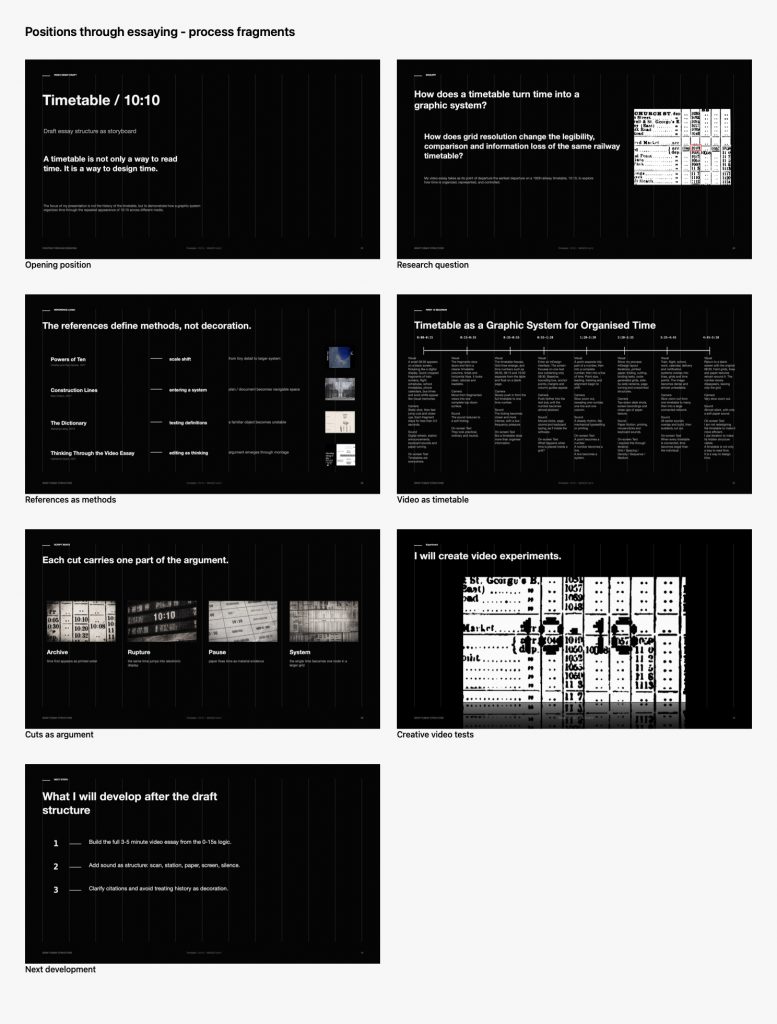
- Opening position: a timetable designs time — The video essay begins from the final position: a timetable is not only a way to read time, it is a way to design time. Source PDF, page 1.
- Research question refined for video — The question is compressed for a viewer: how does grid resolution change legibility, comparison, and information loss? Source PDF, page 3.
- References define methods, not decoration — References are assigned jobs inside the video rather than appearing as decoration. Source PDF, page 5.
- Video structure as organised time — The storyboard turns the video itself into a timetable: each section occupies a time slot. Source PDF, page 8.
- Each cut carries part of the argument — Archive, rupture, pause, and system define what each kind of footage must do; editing becomes argumentative rather than illustrative. Source PDF, page 11.
- Creative video experiments — The draft proposes tests with archive fragments, paper, scan texture, and screen material. Source PDF, page 13.
- Next development after feedback — Feedback clarified the next step: sound, subtitles, paper texture, and citation must all carry part of the argument. Source PDF, page 15.
Full presentation archive
The embedded PDF below is kept as the complete Week 6 presentation record.