Process notes
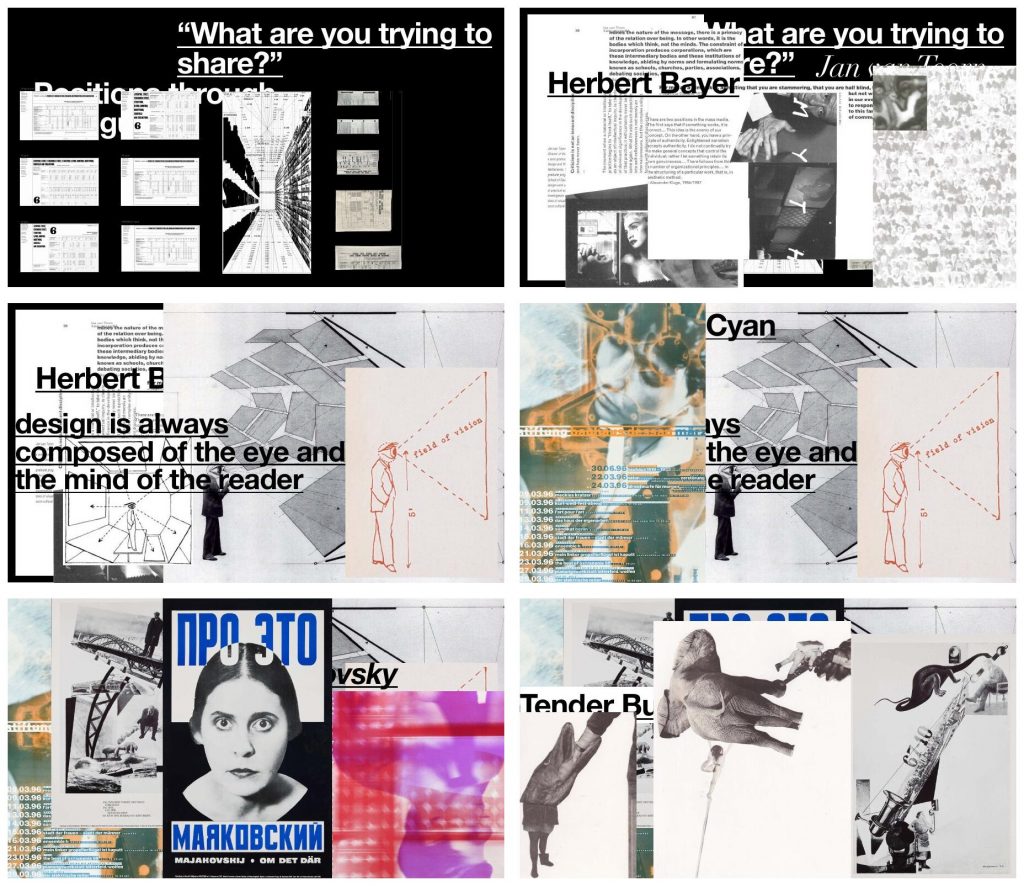
This page opens Year 2 of Unit 2. It brings together two dialogues that helped me clarify my interest in how graphic structures shape reading. The written response above reports on the first; the presentation below layers both into a single accumulating board, so each reference is laid over the previous one rather than replacing it.
Paul Bailey: “What are you trying to share?”
My first dialogue was a one-to-one tutorial with Paul Bailey. I showed him the Timetable Resolution Study, in which I kept the same 1928 railway timetable constant and tested it through different grids (8, 20 and 32 fields, and a three-dimensional grid), scales and media (A4, A3 and newspaper). I explained the project through its method. Paul asked me, “What are you trying to share?” The question made me realise that I had explained my method more clearly than my purpose: demonstrating formal difference was not yet the same as articulating a position.
Paul introduced two references. Jan van Toorn’s “Design and Reflexivity” (1994) argues that communicative design often presents ideological choices as universal and evident, and that reflexive practice should expose the interests built into mediation. Herbert Bayer’s “extended field of vision” uses angled panels, changing scales and multidirectional displays to activate the viewer’s body and gaze — but, as later commentary on Bayer points out, the same expanded field also choreographs movement. Paul summarised it in one sentence: “Design is always composed of the eye and the mind of the reader.” These references helped me understand that design does not only arrange information; it also shapes how information is seen and understood.
Cyan: dialogue through making
My second dialogue developed during a two-week DSA workshop with Cyan, the Berlin design studio of Daniela Haufe and Detlef Fiedler. It was not a formal interview. It happened through daily making, conversation and critique. In the presentation I show some of Cyan’s own work, followed by the photomontage references they shared with us, including Mayakovsky, Rodchenko and Yuri Rozhkov.
I responded by making a bilingual collage book based on Gertrude Stein’s Tender Buttons. Cyan encouraged me to trust my sense of composition and to work in a freer and more abstract way. Where Paul read my work as information design, Cyan read it as composition.
From dialogue to a research question
Together, the timetable and the book explore two different conditions of reading: one organises reading through grids and clarity; the other opens it through collage, white space and the sequence of pages. Both dialogues pushed me towards the same question: how can graphic design shape what a reader notices, compares and interprets? △1 starts from this question.
Presentation board