Process notes
The △2 draft presentation asks what travels with an image when it is republished. A figure can persist while its relations change: the heading, the surrounding space, the distant landscape and the immediate ground do not necessarily travel with it.
The main reference is Phaidon’s Map: Exploring the World (2015), where maps are paired through contrast or complementarity rather than chronological order. The layout brings the maps together, while the text keeps their differences legible. This gave me a model of comparison as an editorial act, and a warning that resemblance is not equivalence.
Selected process fragments
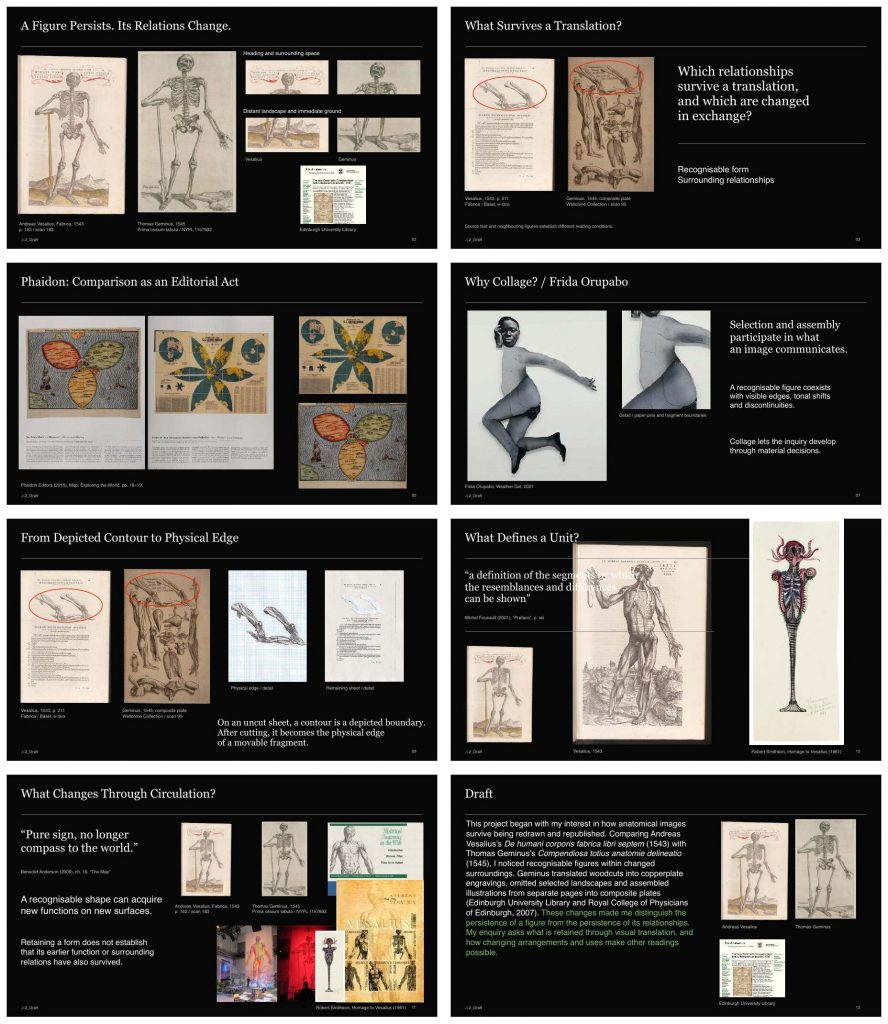
- A figure persists. Its relations change. — Vesalius, 1543 (p. 163) beside Geminus’s Prima ossium tabula: the same skeleton, a different heading, ground and surrounding space. Source PDF, page 2.
- What survives a translation? — Recognisable form survives; the source text and neighbouring figures that set the reading conditions do not. Source PDF, page 3.
- Comparison as an editorial act — Phaidon (2015), pp. 18–19: the layout brings maps together and the text explains their differences. Source PDF, page 5.
- Why collage? — Frida Orupabo, Weather Girl (2021): a recognisable figure coexists with visible edges, tonal shifts and discontinuities; selection and assembly participate in what an image communicates. Source PDF, page 7.
- From depicted contour to physical edge — On an uncut sheet a contour is a depicted boundary; after cutting it becomes the physical edge of a movable fragment. Source PDF, page 9.
- What defines a unit? — Michel Foucault’s “Preface” on the segments by which resemblances and differences can be shown, beside Robert Smithson’s Homage to Vesalius (1961). Source PDF, page 10.
- What changes through circulation? — Benedict Anderson on the map as “pure sign”: retaining a form does not mean its earlier function or relations have survived. Source PDF, page 11.
- Draft — The draft text that became the △2 written response. Source PDF, page 12.