Process notes
Week 02 ended with the anatomical figure. Week 03 followed it back through the archive and turned the search into a focused question: how do changes to an image’s context and arrangement affect how we read? The three starting points from Week 02 — body, map and manuscript — were kept as a frame, but the work concentrated on the body, because its history of copying could be traced page by page.
Sources and republication
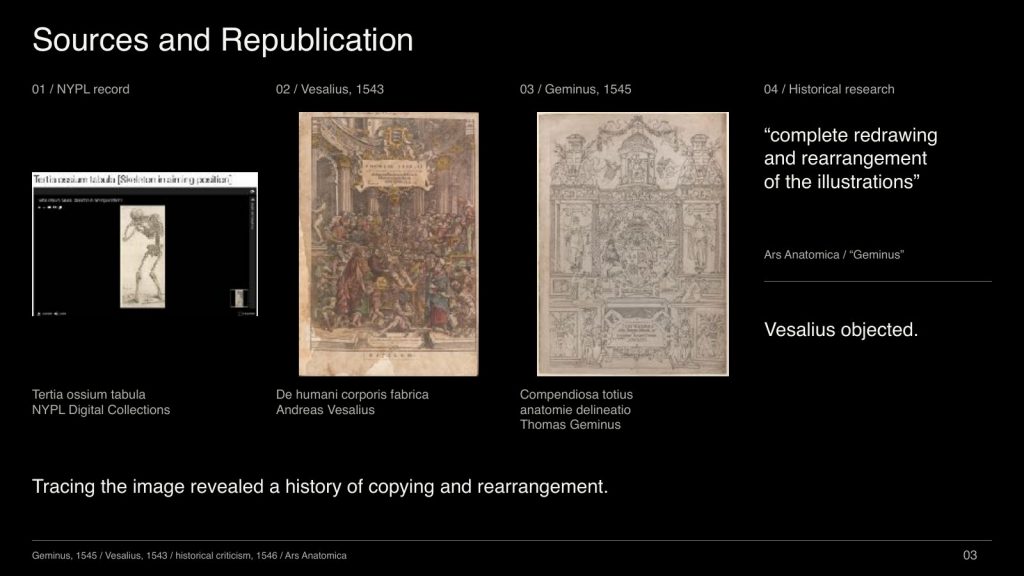
The skeleton I found in the New York Public Library is the Tertia ossium tabula from Thomas Geminus’s Compendiosa totius anatomie delineatio (London, 1545). Tracing it led back to Andreas Vesalius’s De humani corporis fabrica (Basel, 1543). Historical accounts describe Geminus’s book as a “complete redrawing and rearrangement of the illustrations” (Ars Anatomica), and Vesalius himself objected to the copying. The image I had chosen by chance turned out to be a copy with a contested history: tracing one image revealed a whole system of copying and rearrangement.
Setting, text and image
Comparing the two books plate by plate, the first thing that changes is not the body but what surrounds it. Vesalius’s woodcuts were printed together with letterpress on the same page; Geminus’s copper engravings were printed as separate plates. Vesalius places several full-length figures in landscapes, with buildings, plants and ground; Geminus omits the distant landscape but often keeps a prop or a small patch of ground. The body keeps its pose while its surroundings change, and the change of printing technique alters the relationship between the image and its explanation.
Many pages, one plate
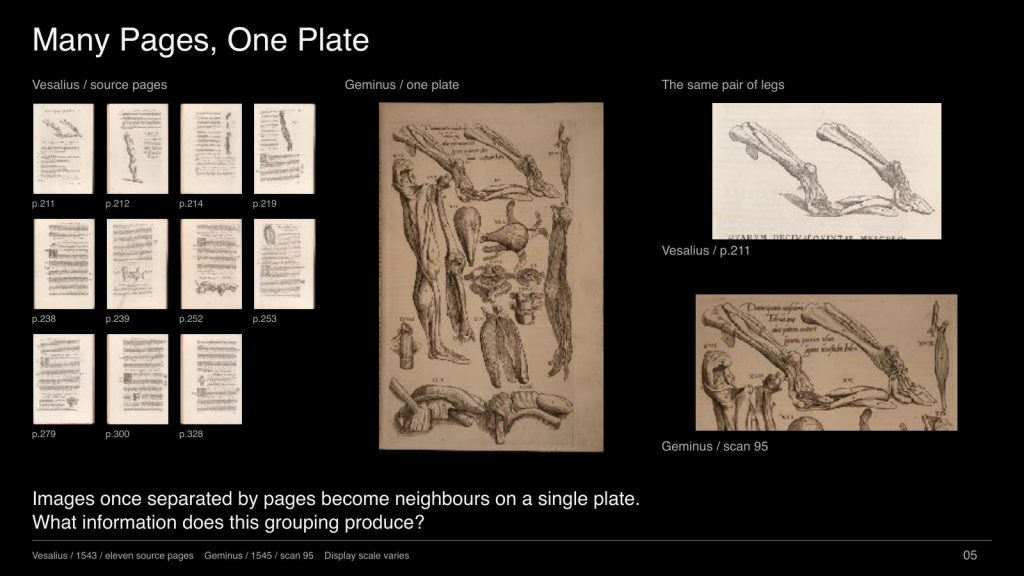
The second change is arrangement. Figures that Vesalius spread across eleven pages of the Fabrica (pp. 211–328) appear together on a single Geminus plate. The same pair of legs that sat alone on page 211 now has new neighbours. In the same way, four pages of nerves in Vesalius become one plate in Geminus. A recognisable figure enters another arrangement, and its new neighbours offer a different route through the page. This raised the question I kept returning to: what information does this grouping produce?
Cutting as reading
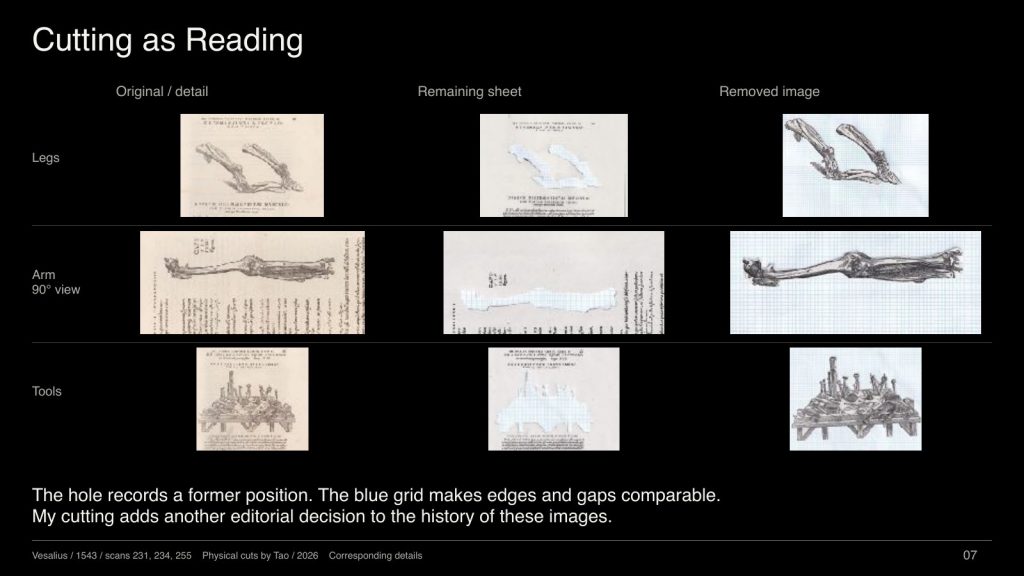
To understand Geminus’s selection from the inside, I repeated it by hand. I printed the relevant Vesalius pages at original scale and cut along the contours of the bodies that Geminus later combined. Each cut produces two objects: the removed image, and the remaining sheet with a hole in it. The hole records the figure’s former position; laid on the blue grid, edges and gaps become comparable. My cutting adds another editorial decision to the history of these images — a contemporary one, made visible rather than hidden.
Fragment atlas
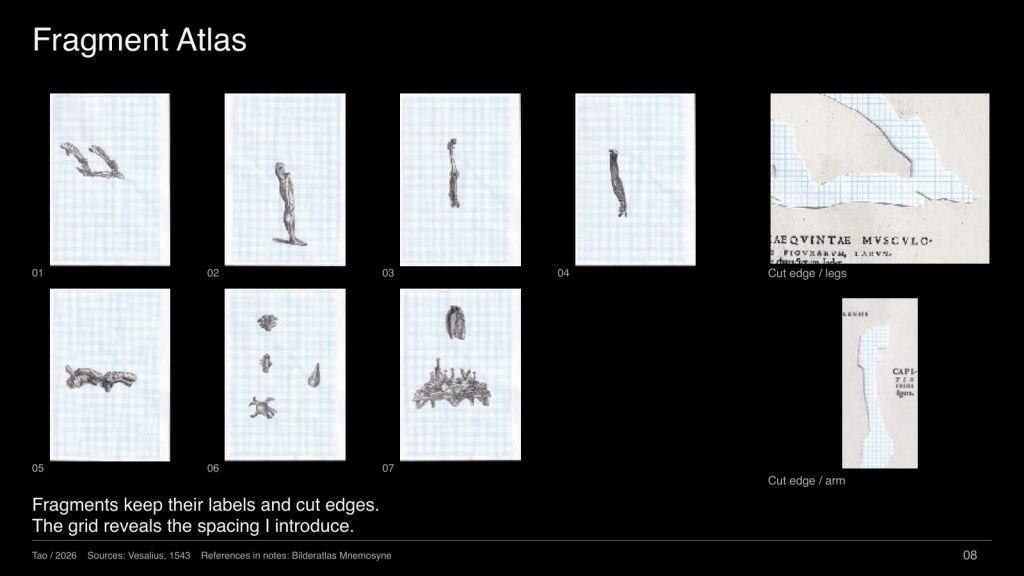
The fragments were then arranged as an atlas. They keep their labels and cut edges, and the grid reveals the spacing I introduce between them. Aby Warburg’s Bilderatlas Mnemosyne (1927–1929, unfinished) was the reference here: an arrangement of images in which meaning comes from proximity and the gaps between panels, not from any single image.
A comparative archive and the viewer as editor
At a larger scale, I built an online archive: taogcd.github.io/out-of-the-picture. Its catalogue connects groups, source pages and corresponding details, so that a reader can follow every comparison back to its sources.
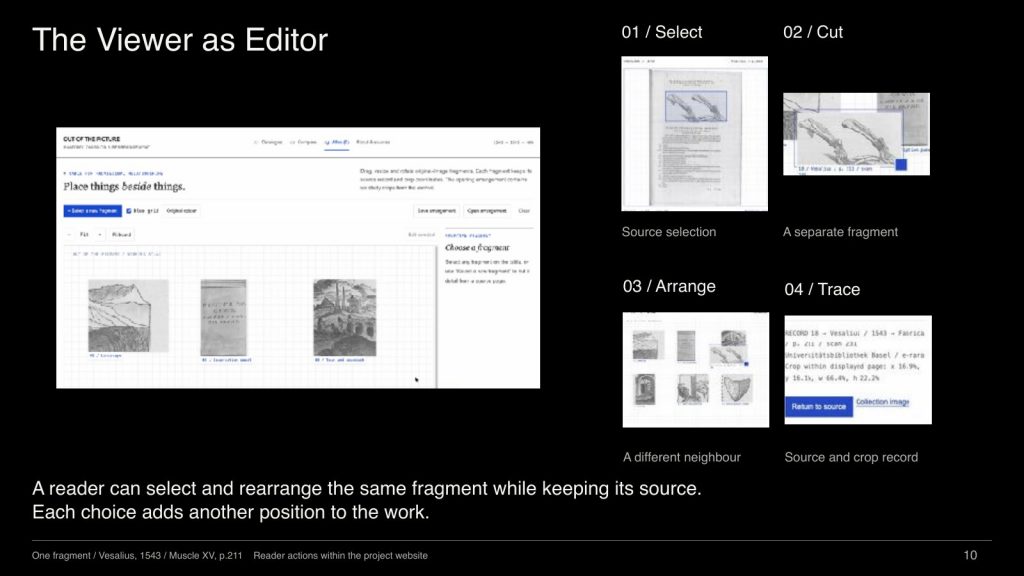
The website also hands the editing over to the viewer. A reader can select a fragment, cut it, arrange it next to a different neighbour and trace it back to its source and crop record. The same fragment can be rearranged while its source stays attached. Each choice adds another position to the work.
The publication
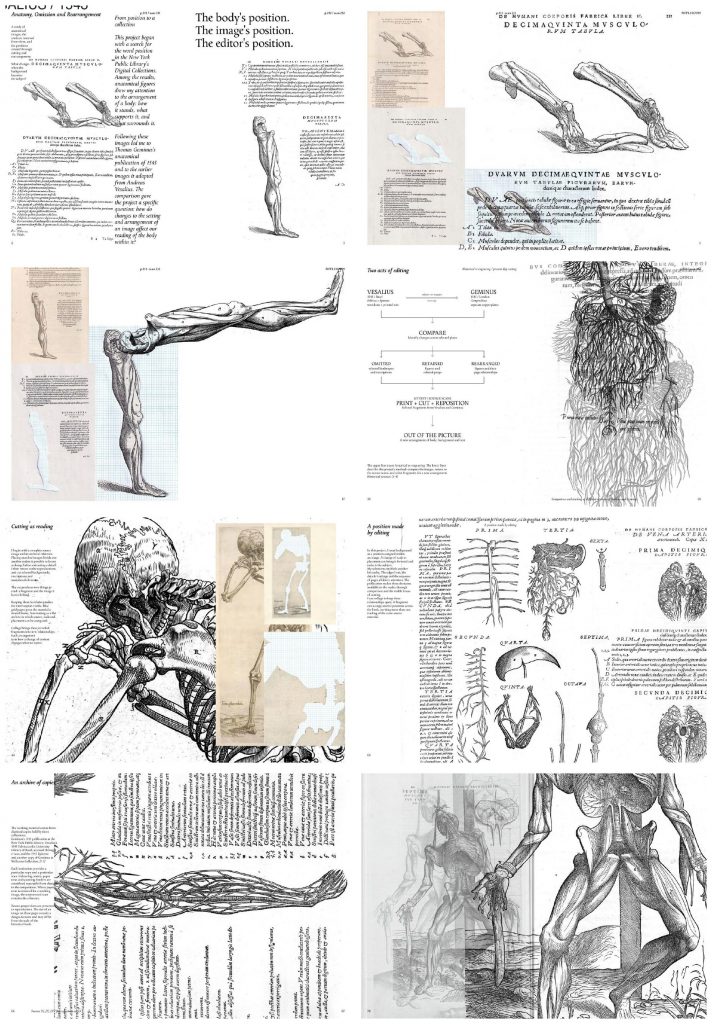
The printed publication, Out of the Picture: Anatomy, Omission and Rearrangement, gathers the comparisons into a chosen sequence. It sets two acts of editing side by side: Geminus’s historical re-engraving and my own cutting. Page turns, scale and overlap shape what the reader can see together: a fragment can occupy several positions across the book, inviting more than one reading of the same source. Unlike the website, where the reader rearranges, the book fixes one route through the archive.
What does rearrangement produce?
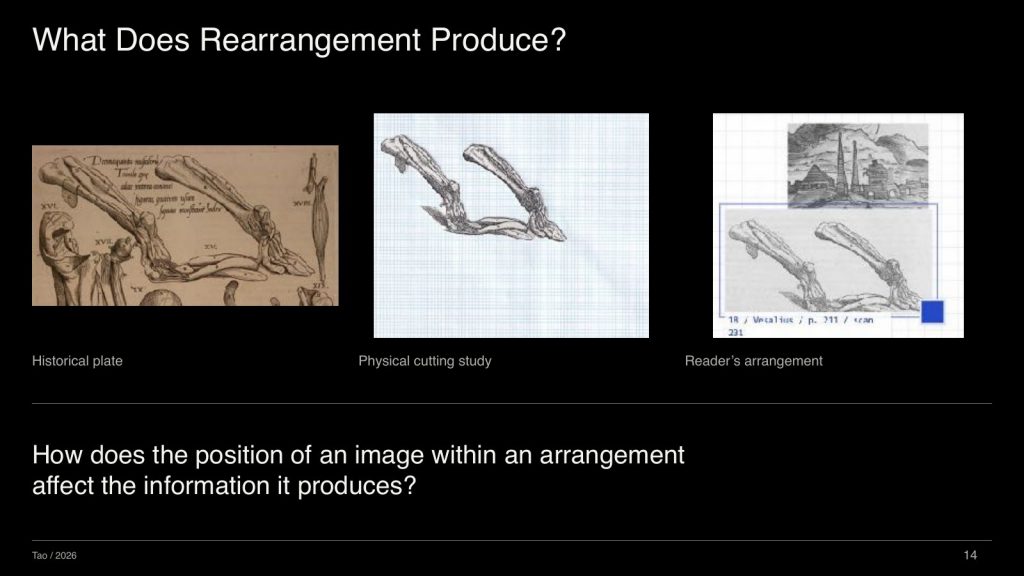
By the end of △1, the same figure existed in three arrangements: Geminus’s historical plate, my physical cutting study and a reader’s arrangement on the website. Setting them side by side sharpened the question for △2: how does the position of an image within an arrangement affect the information it produces?
References this week
- Vesalius, A. (1543) De humani corporis fabrica libri septem. Basel: Oporinus.
- Geminus, T. (1545) Compendiosa totius anatomie delineatio, aere exarata. London.
- Warburg, A. (1927–1929) Bilderatlas Mnemosyne, panels 6 and 77 (reconstruction, 2020).
- Orupabo, F. (2021) Weather Girl.
- Drucker, J. (2014) Graphesis: Visual Forms of Knowledge Production.