Process notes
Week 03 finalised the written submission and rebuilt the symposium presentation, Fitted Rather Than Read, after the feedback of 5 November. That feedback had made two points: the strongest part of my practice is video, and the idea of a “universal” grid is itself a Western position that needed to be examined, with concrete examples rather than generalisation. This week answered both.
Retelling the unit from the grid
The final presentation retells Unit 2 as one line of enquiry. It starts with Josef Müller-Brockmann, who presents the grid as an objective ordering system yet writes that using it means “submitting to laws of universal validity” (1981, p. 10). I read that submission as a choice and tested it. In Timetable I fixed the 1928 railway timetable that Robin Kinross analyses, drew modern grids over it and translated it into Müller-Brockmann’s 8, 20 and 32 field grids, then into a three-dimensional website (taogcd.github.io/timetable) and onto newspaper, A3 and A4 sheets. The dialogues with Paul Bailey and Cyan showed me that legibility is not a property of the information itself but is composed by how its parts are arranged, so I followed “position” as arrangement into Out of the Picture.
The presentation then names the weakness openly: any material would have done. My re-editing method showed how rearrangement changes information, but not where I stood. I had been studying what moves inside the frame, not the frame itself — and across both projects, one thing stayed constant: the grid underneath. By frame I mean what is decided before any content arrives: where things can go, and what cannot enter. Lisa Gitelman’s account of blank forms (“blanks make bureaucracy”, 2014, p. 30) and James C. Scott’s account of legibility as statecraft (1998, p. 2) gave this its name: a grid is fitted rather than read.
Whose universal?
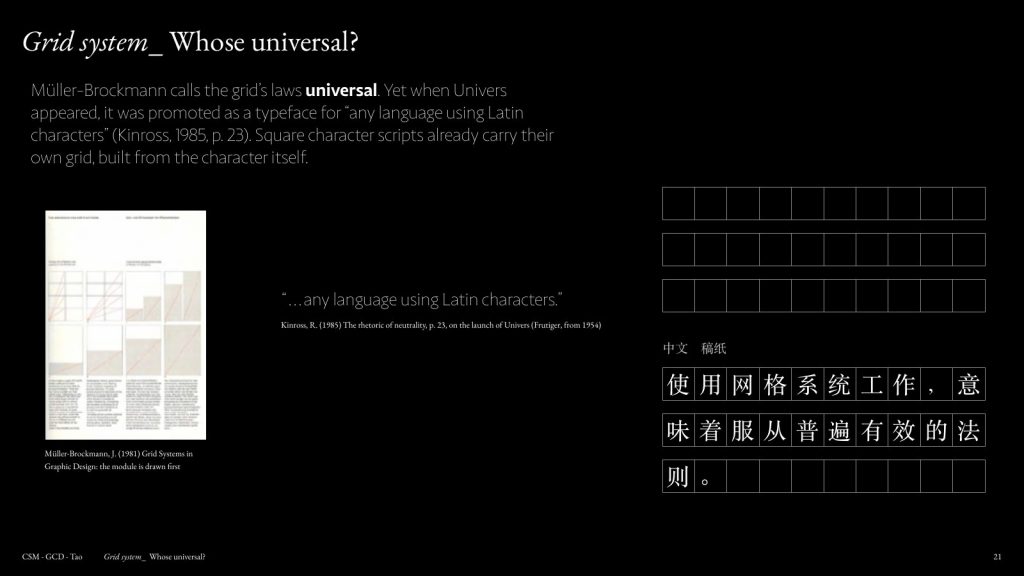
The feedback on universality led me back to Kinross. Müller-Brockmann calls the grid’s laws universal, yet when Univers appeared it was promoted as a typeface for “any language using Latin characters” (Kinross, 1985, p. 23). The universal had limits from the start. Square-character scripts already carry their own grid, built from the character itself: Chinese manuscript paper (稿纸) gives every character its own cell before anything is written. In Müller-Brockmann’s manual, by contrast, the module is drawn first and the Latin text is fitted into it.
One sentence, different grids
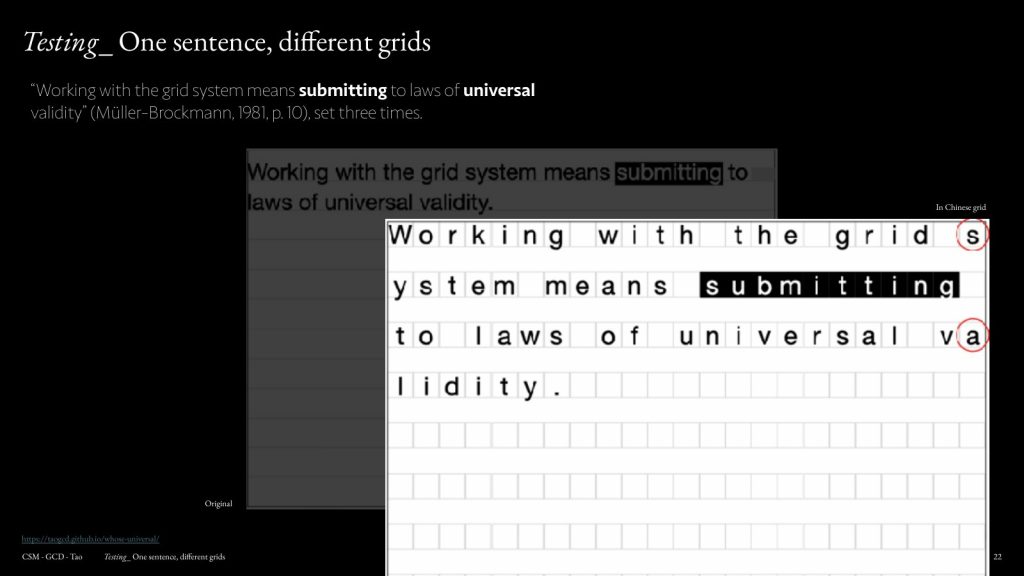
So I reversed the test. Instead of fitting one source into different Western grids, I took Müller-Brockmann’s own sentence — “Working with the grid system means submitting to laws of universal validity” (1981, p. 10) — and set it three times: in its original setting, in a Chinese manuscript grid and in other grids built from other scripts. In the Chinese grid, each Latin letter occupies a cell meant for a whole character; words are split at the end of each line (“s / ystem”, “va / lidity”). The sentence that claims universality is the one that cannot fit without repair. Whatever is not the mirror of the grid has to adapt to it.
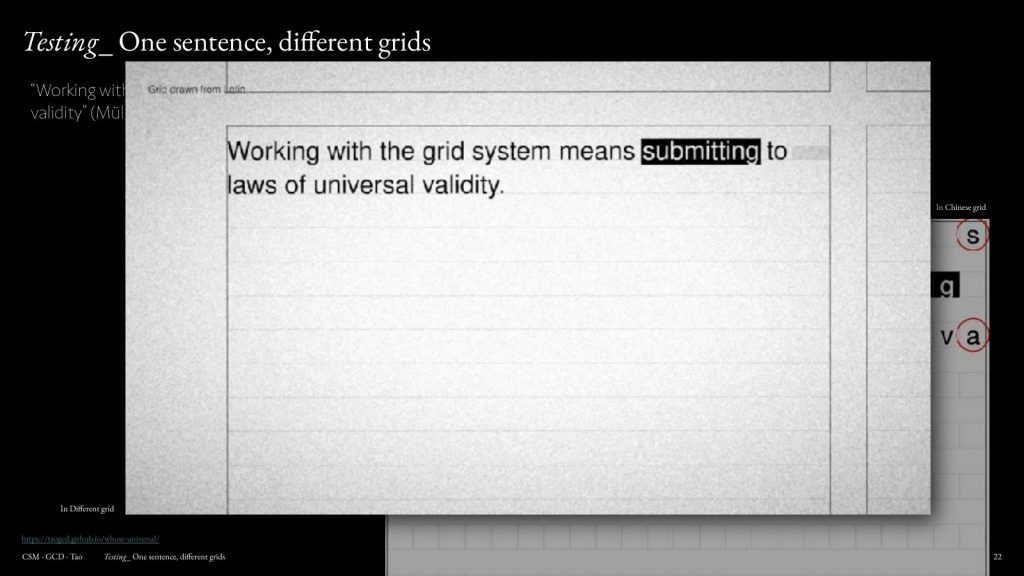
The test is available as a website: taogcd.github.io/whose-universal.
Summary video
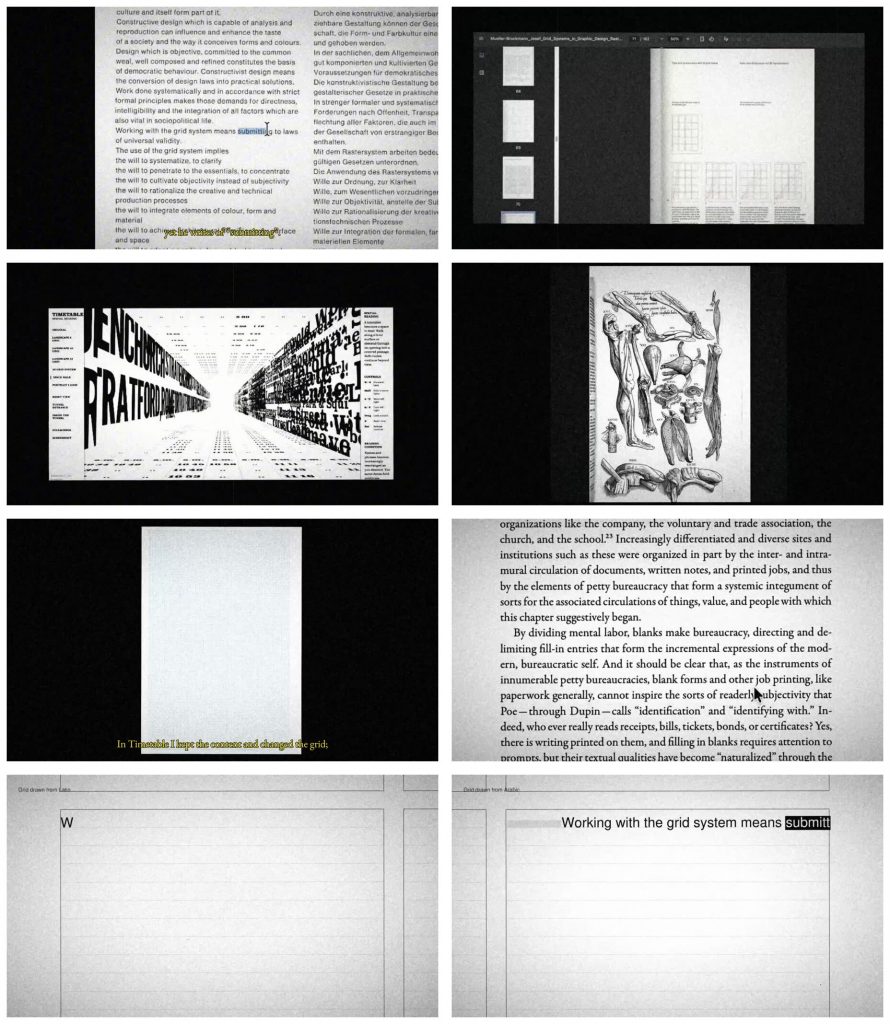
Because video had been identified as the strongest part of my practice, I condensed the whole unit into a 90-second film with spoken lines and subtitles. It sets the two studio projects against each other: in Timetable I kept the content and changed the grid; in Out of the Picture I changed the content and never touched the frame. What stayed the same was the frame. The video ends on the grids drawn from different scripts.
Position now
My position has moved from asking whether design is neutral to asking which elements of the modernist grid embody bureaucracy and which leave room for the designer’s discretion — now that the grid is built into design software and given to us before we begin.