Process notes
This page records how the first Unit 2 enquiry moved from a simple rule-based code system into CONTACT, a tool for testing how different machine-vision apparatuses construct different versions of the same event.
The full written response remains above as the formal submission document. The notes below break the presentation into visible stages so the process can be read without opening the whole slide deck.
CONTACT web tool
https://ttttttttaaaoooooooo-sudo.github.io/contact CONTACT web design
Selected process fragments
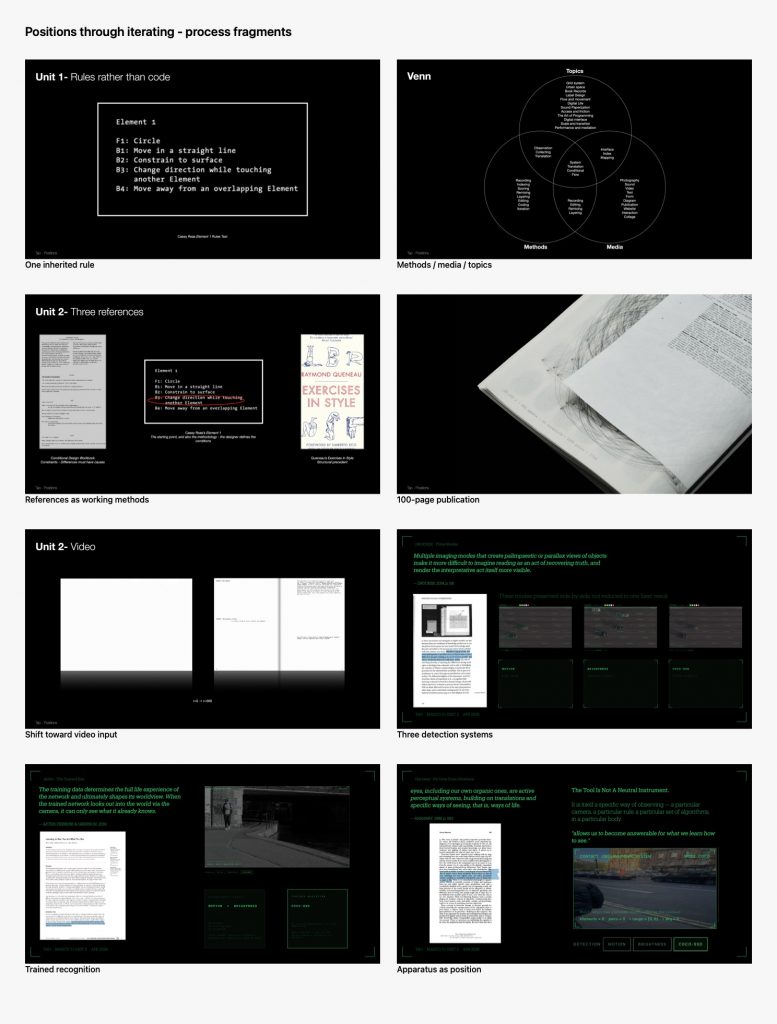
- One inherited rule — The enquiry begins with Casey Reas’s Element 1, using B3 as the smallest possible rule: when two elements touch, register the contact. Source PDF, page 3.
- Methods / media / topics — The Venn diagram locates the work between code iteration, image systems, print, and questions of observation. Source PDF, page 9.
- References as working methods — The references define how a rule can be executed, repeated, and tested against material that does not fully obey it. Source PDF, page 14.
- 100-page publication — The first week turns repetition and small variation into a printed object, making the iterative process physically inspectable. Source PDF, page 19.
- Shift toward video input — The question moves from generated circles to real footage, so the rule meets an input it did not create itself. Source PDF, page 22.
- Three detection systems — Motion, Brightness, and COCO-SSD read the same footage through incompatible forms of detection. Source PDF, page 5.
- Trained recognition — COCO-SSD clarifies the difference between rule-based detection and a trained model that only sees categories already given to it. Source PDF, page 8.
- Apparatus as position — The final position is not to decide which detector is correct, but to show how the apparatus decides what can count as contact before the rule runs. Source PDF, page 11.
Full presentation archives
The embedded PDFs below are kept as the complete presentation records for Week 1 and Week 2.